Tools › Truing Solver
Truing Solver
Find the muzzle velocity that makes your real drop match the math. Closed-form solve from the predicted drop your solver gave you and the measured drop you actually got at distance.
What These Words Mean
- Drop
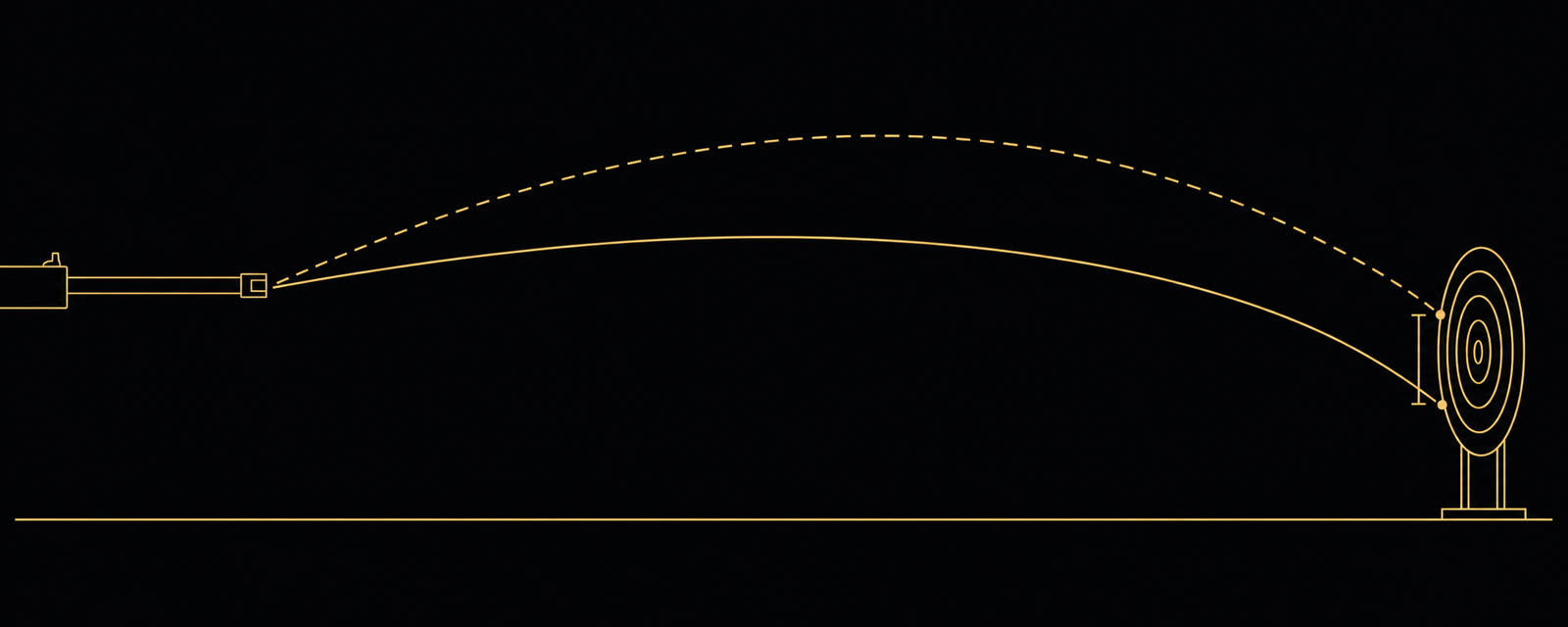
- How far below your aim point the bullet hits at long range, because gravity pulls it down during the flight. Measured in inches, MOA, or Mils.
- Muzzle velocity (MV)
- How fast the bullet leaves your barrel, in feet per second. The faster it goes, the less it drops over a given distance.
- Ballistics solver
- An app or website that predicts where your bullet will hit at long range based on the speed it leaves your barrel and how aerodynamic it is. Strelok, Hornady's 4DOF, Applied Ballistics are common ones.
- Predicted drop
- What the solver app told you would happen.
- Measured drop
- What actually happened when you shot the load at distance.
- Truing
- Adjusting the muzzle velocity number you feed your solver so its predictions match what your rifle actually does. Once trued, the solver becomes accurate for shots at other distances too.
What This Solves
Your ballistics app said the bullet would drop X amount at distance. You went and shot it, and the actual drop was different. That's normal. No app gets your specific barrel right the first time. This tool tells you what muzzle velocity to type into your solver so its predictions line up with reality. Once you do that, every future shot the app predicts will be much closer to where the bullet actually lands.
The math: a small change in muzzle velocity makes a roughly double-sized change in drop at long range. We solve for the muzzle velocity that makes predicted drop match measured drop exactly.
Inputs
How The Solve Works
Drop is approximately 0.5 · g · t², where t is time of flight. Time of flight scales as R / V_avg, and V_avg is closely tied to the muzzle velocity for a given load over modest corrections. So drop scales as 1/V². To bring predicted drop to measured drop, the trued MV is:
V_trued = V_chrono × sqrt(predicted_drop / measured_drop)
If your measured drop was bigger than predicted, the bullet was slower than your chrono said, so MV gets corrected down. If measured was less, MV corrects up. Beyond about a 5% correction, your chrono or your BC is the bigger source of error and the simple formula starts to bend; track that down before chasing more decimal places.
Why this is honest. Browser ballistics solvers that pretend to do full G7 numerical integration usually quietly mis-calibrate at long range. The truing math is just a ratio you can verify on paper. The full multi-point truing workflow lives in the BrassTracker app, where it cross-fits MV against multiple measured drops and your saved chrono history.
Disclaimer. Educational. Not load data. Always verify against a current published reloading manual.