Progressive vs Single-Stage: Which Press Fits Your Volume
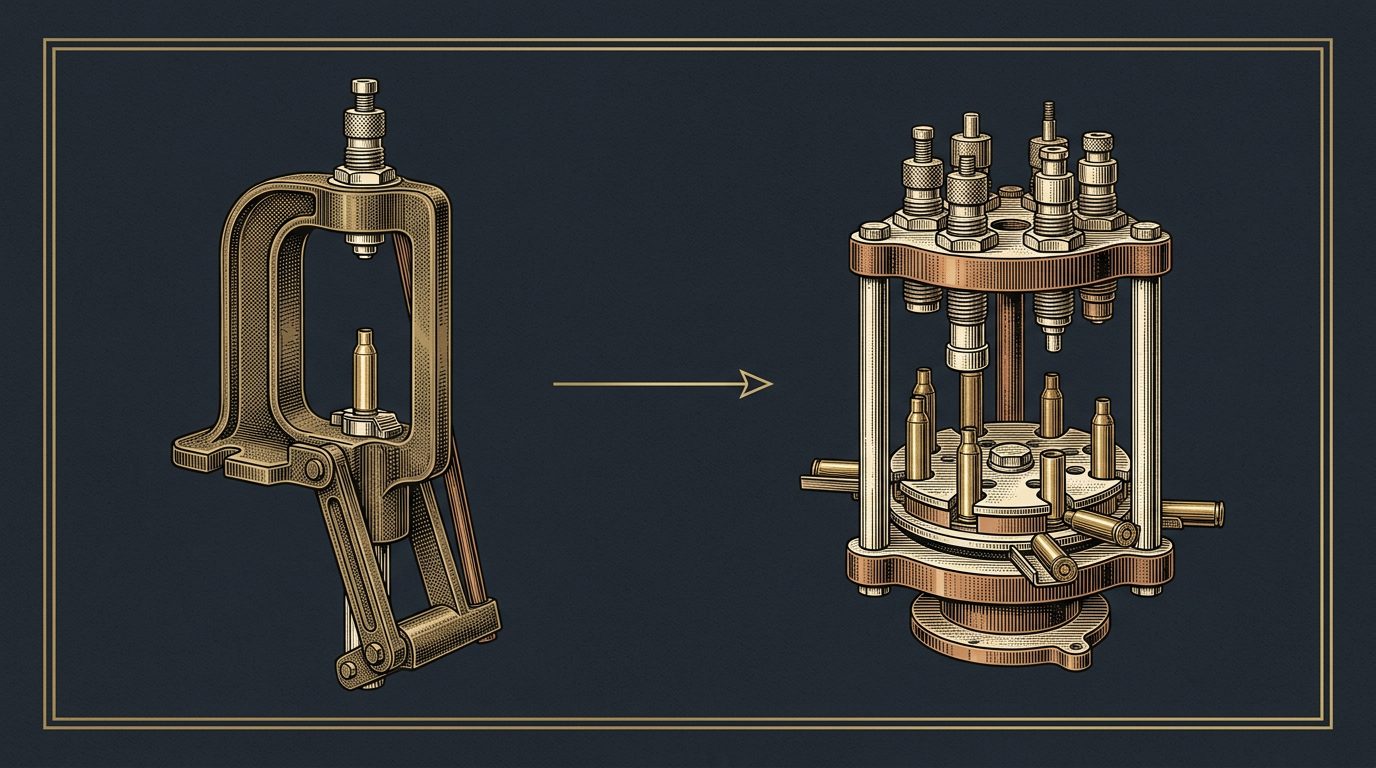
There is no "best" reloading press. There is the press that fits your cartridge, your volume, and your tolerance for setup time. This is the short version of how to choose.
The Trade
| Single-stage | Turret | Progressive | |
|---|---|---|---|
| Operations per pull | 1 | 1 (rotates head; most auto-index) | 4 to 8 (every station fires) |
| Rounds per hour | 50 to 150 | 100 to 250 | 300 to 800+ |
| Setup time | Low | Low | High (per cartridge) |
| Best for | Precision rifle, load workup | Mid-volume rifle/pistol | Handgun, AR-15, action shooting |
| Inspection per round | 5 hands-on touches | 3 hands-on touches | 1 hands-on touch |
| Typical first cost | $150 to $300 | $250 to $450 | $400 to $2500+ |
Single-stage = one die, one operation per pull. Turret = a rotating die head that swaps dies for you, one operation per pull. Progressive = a shellplate that advances a case through every station on every pull.
Match-grade rifle loads almost always come off a single-stage. High-volume USPSA, 3-gun, and casual range plinking almost always come off a progressive. The interesting question is the middle ground.
Volume Math
Pick a number for your annual round count. Then divide by the rate column. That is your hours at the bench.
- 2,000 rounds/year of .308 for hunting + practice. A single-stage at 80 rds/hr = 25 hours/year. Bearable. Progressive setup cost is hard to justify.
- 5,000 rounds/year of 9mm for USPSA. A single-stage at 100 rds/hr = 50 hours/year, which is a part-time job. A progressive at 500 rds/hr = 10 hours/year. The progressive pays back in a year.
- 15,000 rounds/year of .223 for high-power and varmint. A turret splits the difference: ~150 rds/hr = 100 hours/year, which is too much. Most high-volume rifle reloaders end up on a progressive (Dillon 650 / 750, RCBS Pro Chucker 7) and pay the setup-time tax in exchange for the throughput.
What Does "Automated" Actually Mean?
The word "automated" gets thrown around for everything from a Dillon 1050 with a case feeder to a Mark 7 Evolution with auto-drive. The honest hierarchy:
- Manual-index progressive. You pull the handle, then advance the shellplate one station yourself. Dillon 550 / 550B is the canonical one, manual index by design.
- Auto-indexing progressive. The shellplate indexes on the down-stroke automatically. Dillon 650 / 750 / RL 1100, Hornady Lock-N-Load AP, RCBS Pro Chucker, Lee Pro 1000 / Loadmaster.
- Case-fed progressive. A case feeder drops cases into station 1 automatically. You still pull the handle.
- Auto-drive progressive. A motor pulls the handle for you. The Mark 7 Autodrive, Mark 7 Evolution, Ammobot. Hands-off except for refilling components and clearing jams. Industrial scale.
For tracking purposes, the difference between #1 and #4 is mostly inspection cadence, not what gets logged. You still record the bullet, powder, charge, primer, brass, OAL, and lot. The press just decides how fast those rounds happen.
What Does NOT Change
Three things are independent of press type:
- You still need to verify charge weight. The most common cause of catastrophic over-pressure incidents is a powder measure throwing wrong, not a single-stage error. Progressives need a powder check die and frequent random weight checks.
- You still need to track brass life. A brass case fired through a Dillon 1050 is not somehow tougher than one resized on a Rock Chucker. Annealing schedule, neck splits, and primer pocket loosening all happen the same way.
- You still need a logbook. Round count per firearm, charge per load, group per session. The press changes throughput; it does not change the data you should be recording.
Most Reloaders End Up with Both
Most handloaders who stick with it longer than a year end up with both presses. A single-stage on the bench for rifle workup, a progressive for the volume cartridge that pays for the hobby (usually 9mm or .223). The two presses do different jobs. Owning both is normal, not redundant.
If you are buying your first press right now and are not sure: get a single-stage. You can always graduate to a progressive later. The opposite, going from progressive back to single-stage for one ladder test, is a gear-shift that most reloaders learn to dread.
What to Track in BrassTracker, Regardless of Press
- One load recipe per recipe per firearm. Different rifle, different recipe, even if the bullet/powder/charge are identical, the rifle's twist and freebore will give you a different group.
- A chrono session per range trip. ES, SD, and average roll up automatically.
- A firing event per brass lot per session, so brass life ticks up the same way it does on the case head.
- Cost per round per recipe, with the math kept honest by component lot prices.
The press you use does not change any of that.
Try BrassTracker
BrassTracker is $2.99 once, yours to keep. Single-stage workups, progressive batches, automated runs, same logbook, same data, same answer to "which load shoots tightest in this rifle".