Group Size Math: MOA, Mil, ES, SD
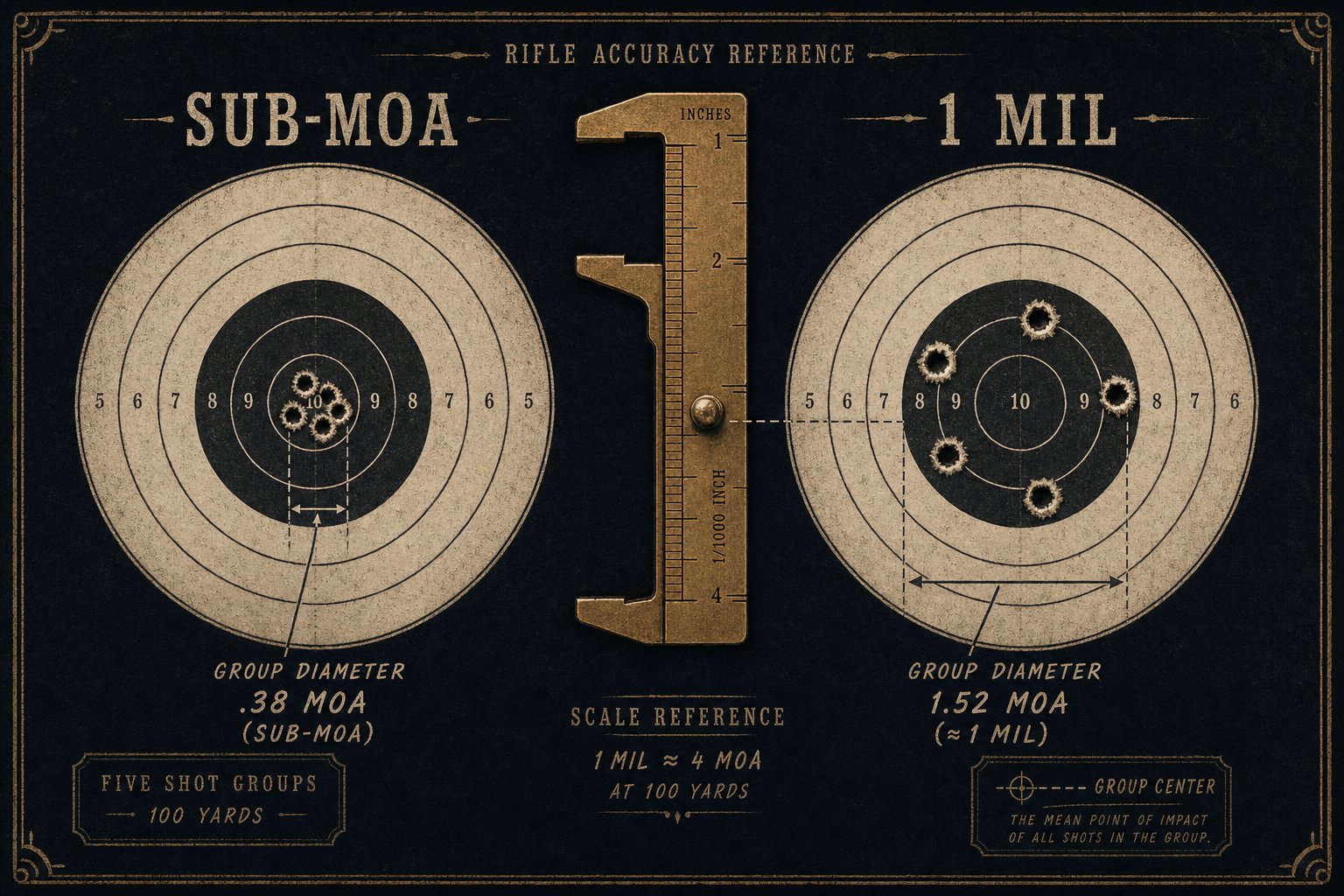
Four numbers and what they actually mean. The same explanations live inside the app behind the (?) buttons; this page is the canonical written version.
Group Size: Center to Center
A group is the cluster of holes you put on the target. The standard measurement is center to center between the two widest shots. Reported in inches, MOA, or mil.
If you measure outside-edge-to-outside-edge instead, subtract one bullet diameter to get center-to-center. Most rangefinders / target software now does this automatically.
MOA: Minute of Angle
1 MOA = 1/60 of a degree. It subtends roughly 1.047 inches at 100 yards (commonly rounded to 1"). At any distance, multiply by the distance in hundreds of yards:
| Distance | 1 MOA equals |
|---|---|
| 100 yd | 1.047" |
| 200 yd | 2.094" |
| 600 yd | 6.28" |
| 1000 yd | 10.47" |
Most American optics use MOA-graduated turrets and reticles. A "half- MOA rifle" is one that puts five shots into a 0.5" circle at 100 yards.
mil: Milliradian
1 mil = 1/1000 of a radian. It subtends roughly 3.6 inches at 100 yards or 10 cm at 100 m. Most European optics and modern American precision optics use mil reticles.
| Distance | 1 mil equals |
|---|---|
| 100 yd | 3.6" |
| 100 m | 10 cm |
| 600 m | 60 cm |
| 1000 m | 100 cm (1 m) |
Conversion: 1 mil = 3.438 MOA. Don't mix optics: an MOA turret with a mil reticle (or vice versa) makes wind correction unnecessarily painful.
ES: Extreme Spread
The difference between the fastest and slowest shot in a velocity string. Sensitive to outliers - a single flier from a poorly-seated primer can blow up your ES while the rest of the string is fine.
ES is most useful as a catastrophic-flier detector. If your ES is more than ~3× your SD, you have flier(s) worth investigating.
SD: Standard Deviation
Statistical spread of the velocity string. Lower SD = more consistent ignition = tighter vertical at long range.
| SD (fps) | What it means |
|---|---|
| 5 or below | Match-grade reloading, consistent ignition |
| 6-10 | Normal, well-developed handload |
| 10-15 | Acceptable for hunting; vertical visible past 600 yd |
| 15+ | Re-work the load; primer/charge consistency issue |
Use SD over ES once you have ≥10 shots in the string. With 5 shots or fewer, SD is too noisy to trust - fall back on ES.
Why This Matters at Long Range
Velocity SD multiplied by time of flight gives you the vertical spread in inches at the target. Rough rule for a typical .308 Win 175gr at 2700 fps:
- 600 yards: every 10 fps SD ≈ 1" vertical
- 1000 yards: every 10 fps SD ≈ 3-4" vertical
So a 5-fps SD load shoots a 5-inch vertical group at 1000 yards purely from velocity variation, before wind, before mirage, before shooter error. A 15-fps SD load opens up to 15 inches at the same distance - that's miss territory on most game and most matches.
Sample Size Honesty
Most chronograph displays compute SD on whatever shots you've fired so far. With 3 shots, SD is mostly noise. With 5 shots, it's a rough indicator. With 10 shots, it's meaningful. With 30 shots, it's a serious statistical estimate.
BrassTracker shows SD only when n ≥ 5 and labels SD as "approximate" until n ≥ 10. ES is always shown.